


This year, at ReBuild Ukraine in Warsaw, FSC worked with a well-coordinated international team. Representatives from Poland, the Baltic states and Ukraine were joined by FSC International experts to demonstrate once again that: the solutions proposed by our organization provide a solid foundation for the sustainable reconstruction of the country.
For the third consecutive year, FSC Ukraine is participating in ReBuild Ukraine. The international expo has an ambitious goal: bring together everyone who can help with the reconstruction, give them the opportunity to establish professional connections and find reliable partners in the future. For FSC, the event was yet another opportunity to work together as a team to hold dozens of meetings and presentations for various groups of exhibition participants.
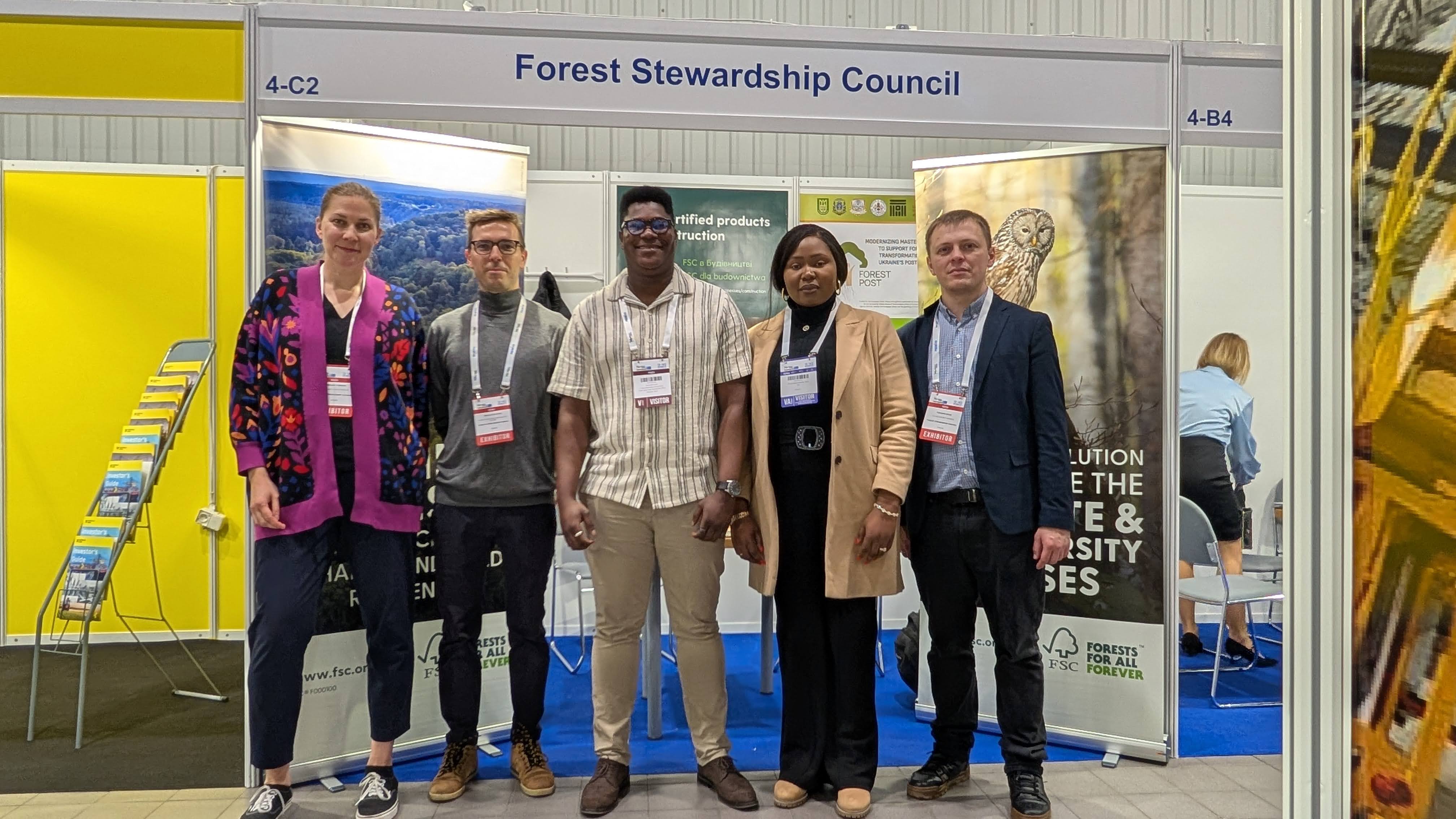
This year, the event in Warsaw attracted visitors not only from Europe, but also from other regions of the world: the United States, Japan, and Taiwan. In total, there were over 700 exhibitors from 33 countries. Government officials, municipalities, industry leaders, construction and energy experts, and investors have created a unique platform for constructive dialogue and practical cooperation. FSC's participation created a unique opportunity to convey more information about its mission to participants.
“This is a great opportunity to promote the mission of FSC among a wide variety of stakeholders in the region, but for our team it is also a small gesture of support for our colleagues in Ukraine,” Karolina Tymorek, FSC Poland country manager, emphasised. “The expo is expanding every year, and we could observe that it also reflects current developments related to the international engagement in the reconstruction of Ukraine. We are always happy to attend the event because there is always significant interest in our stand; we have truly productive discussions with visitors, and we also know from our Ukrainian colleagues that this translates into better recognition of FSC in Ukraine, which makes our efforts even more worthwhile," Karolina Tymorek added.
The showcase audience was diverse, but with a clear focus on reconstruction: representatives of the construction sector, companies working with traditional materials and innovative solutions for sustainable construction, as well as participants interested in partnership formats and cross-sector cooperation.
“Particular interest from representatives of large purchasing groups. They are interested in the state of the Ukrainian forest sector and timber market, in particular access to sustainable materials and reliable supply chains to ensure sustainability in both reconstruction and international trade development processes," Yevhen Khan, FSC CoC and Integrity Manager, comments. “Colleagues from FSC International, FSC Poland and FSC Baltic joined the collaboration on site. Their participation is important both for strengthening the FSC’s position as a whole and for demonstrating international consistency in approaches to forest product sustainability.”
Three focus areas
In general, questions from visitors to the stand and participants in the event focused on three key topics. Firstly, what is happening with the timber market in Ukraine right now and what are the prospects for stable supply in the medium term. Secondly, how to apply sustainability criteria for Ukrainian timber both in the domestic market and when exporting to the EU. At the same time, how to verify the origin of materials and ensure transparency throughout the supply chain.
Thirdly, the investment dimension – what ‘safeguards’ and confirmation of sustainability are needed by investors and how FSC tools work in this regard.
Agnes Pidrika, market development officer, Latvia and Lithuania, noted an important trend: “When we think about rebuilding Ukraine, we must also focus on sustainable development. Do not forget this when communicating with stakeholders. But this year, we noticed another important thing: many people who approached us to talk already knew about us, the values of the FSC and the mission we carry”.
Aidas Pivoriunas, FSC Project Manager in the Baltic States, shared his observations: "Every other question was about one thing: can we guarantee that the resources for rebuilding Ukraine can be considered sustainable? Yes, if they are FSC certified. Many people asked: perhaps it would be better to bring materials from other countries? No, sustainable materials are already available in Ukraine. The certification proves it. This is the key message: we have everything we need in Ukraine. And this must be recognised globally.”
The FSC team's standpoint during the talks was consistent: Ukraine already has a significant segment of responsible forestry businesses focused on exports and established sustainability practices. And it is precisely this that should be one of the elements of rebuilding, if clear rules of the game are created for it and there is an opportunity to realise its potential on the domestic market. Separately, colleagues from the FSC emphasised the need for cascading use of wood, which provides maximum benefits both for the economy and for the implementation of climate-oriented solutions in reconstruction. They primarily relate to the role of timber in the carbon cycle as a carbon-storing material.
The investment dimension of sustainability
The topic of investment was raised in a report by Oluwatimilehin Ifeoluwa Talabi, a representative of FSC International, as part of the Community Marathon at Rebuild Ukraine. She revealed how FSC standards and certification reduce ESG risks for investors, simplify due diligence procedures and increase confidence in the forestry sector (ESG (ecological, social, governance) – principles of sustainable development that assess the environmental, social, and management activities of companies, states and organizations, taking into account their impact on society and the environment – ed.).
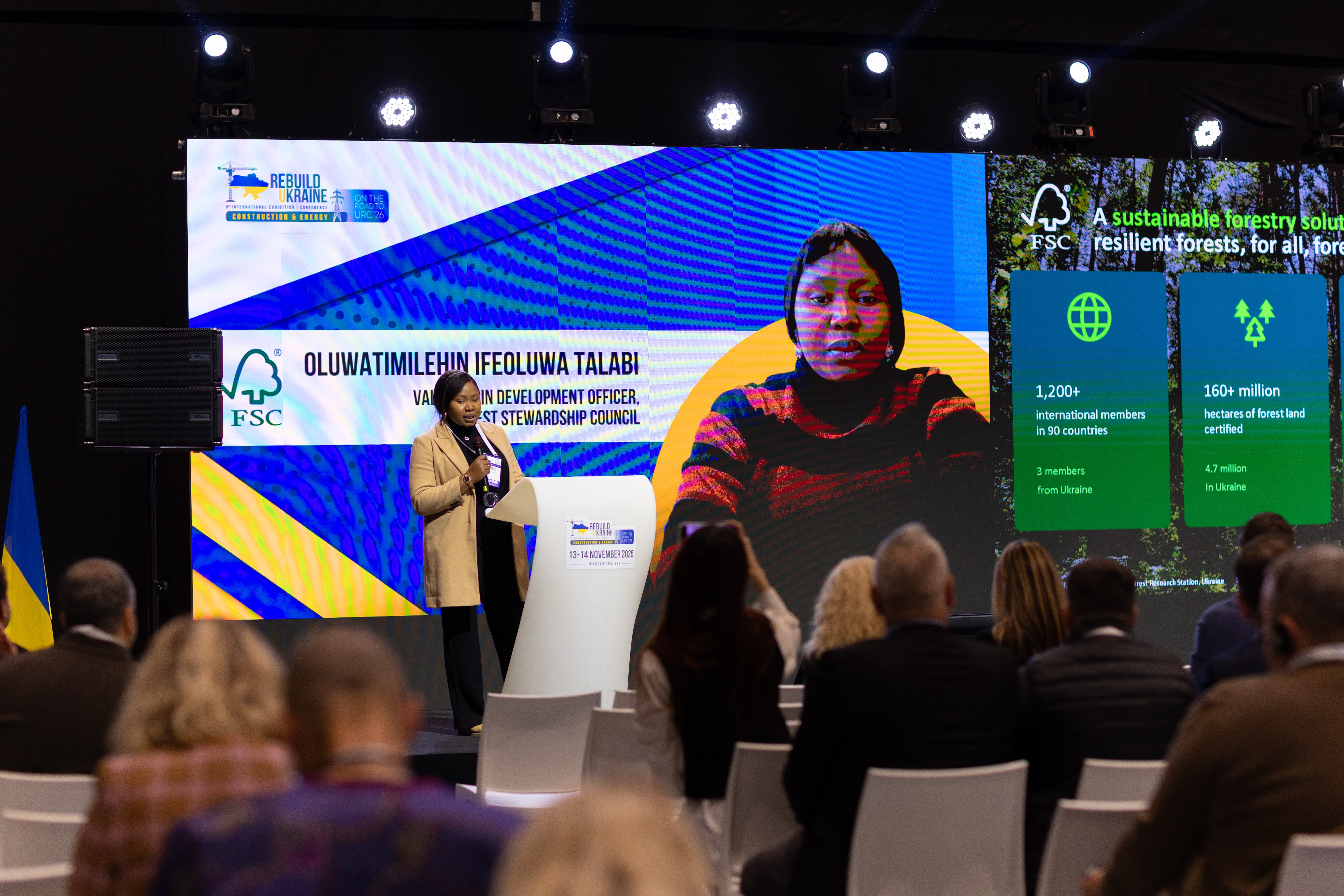
“To ensure that responsible sourcing of construction materials using wood and other forest products remains a focus for donors and international institutions, we need to do more of the following,” the FSC value chain development officer explains. “Form partnerships and build relationships with NGOs and relevant organizations and programmes. Communicate more about the use of wood in construction through presentations at conferences and events to expand the audience that is aware of responsible forest management. Organise programmes that can bring investors and stakeholders together, such as business networking events. Use successful case studies to promote projects in the construction sector on our website. Develop policies and implement certification that is easy for developers and builders to work with.”
This is important not only for the current phase of rebuilding, but also for the long term, when investors from the EU with more demanding sustainability and transparency criteria enter the Ukrainian market.
From contacts to practical cooperation
Another important conclusion: Many projects and initiatives are already being implemented in Ukraine's forest sector, but their visibility to external partners and even to some of the domestic audience is low. Regular platforms for experience sharing and communication between sectors are needed.
A logical continuation of the interest in partnerships that the FSC Ukraine team noticed at ReBuild Ukraine was a series of webinars on effective teamwork, cooperation and partnership building in two parts – on 27 November 2025 and 4 December 2025 (https://ua.fsc.org/ua-uk/newsfeed/seriya-vebinariv-partnerstvo-dlya-stalogo-rozvitku-vid-lisovogo-sektoru-do-zelenoi). The first webinar in the series ‘Partnership for Sustainable Development’ brought together about 50 participants. The speaker was Fredrik Backlund, an expert in organisational development and teamwork from Luleå University of Technology (Sweden) and co-author of the Well-Working Team methodology. The second webinar was developed on the feedback from those who participated in the first part.
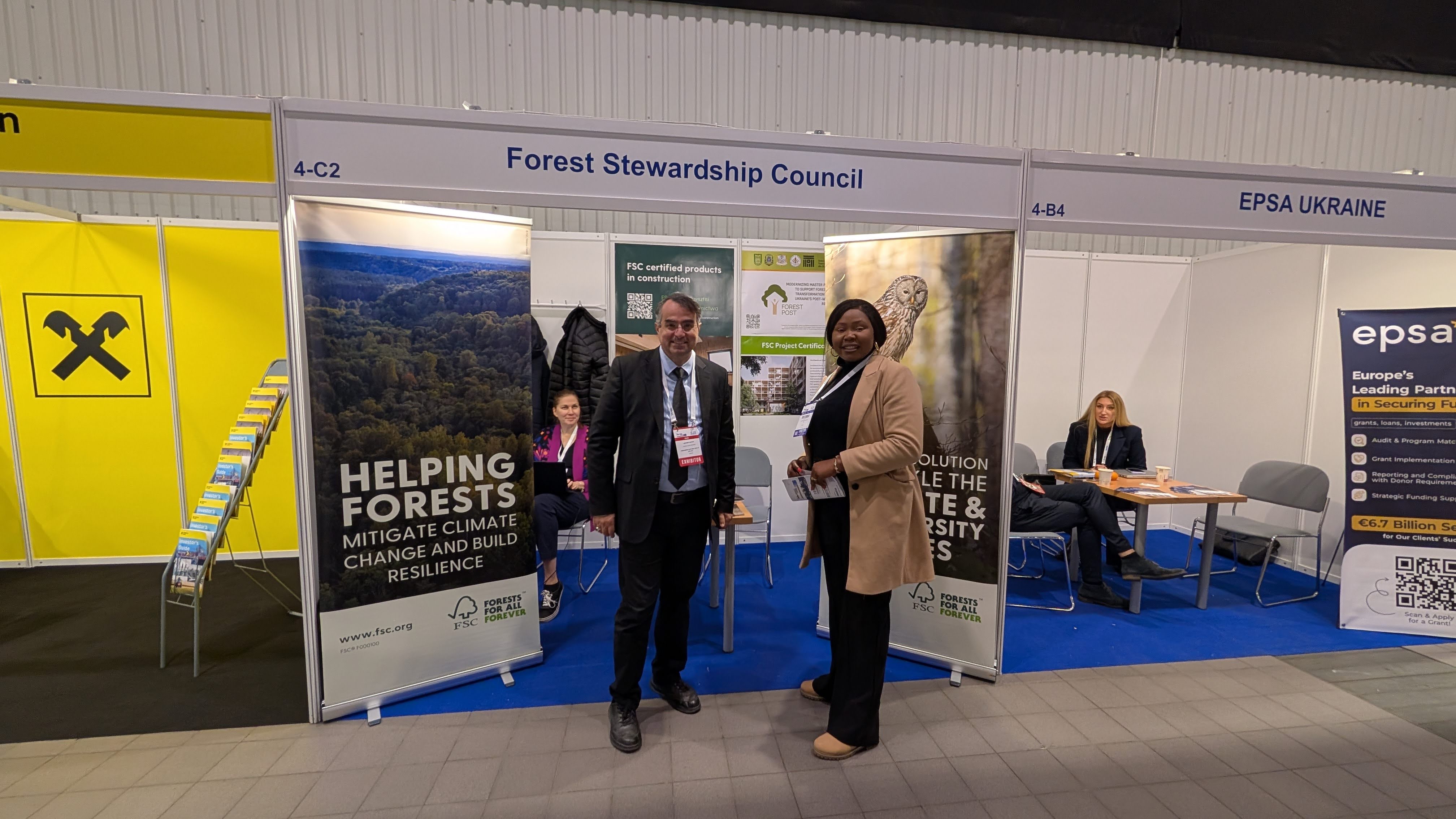
FSC's participation in the international expo ReBuild Ukraine 2025 showed that Ukrainian responsible businesses in the forest sector need to be more proactive. It is necessary not only to tell success stories, but also to explain in figures and facts how responsible forest management contributes to reconstruction, the economy and the fight against climate change. The Ukrainian forest sector is evolving in this direction, and exhibitions such as ReBuild Ukraine are becoming a place where not only new contacts, but also real partnerships for the sustainable reconstruction of Ukraine are born.