Global economic pressures, political instability, armed aggression threatening human life, restricted access to forest sites due to armed conflict, and even wildfires – all of these affect the certification system worldwide.
For countries where FSC operates, these are no longer hypothetical risks but operational realities. The question is whether the system has the tools to respond systematically, rather than address each situation in isolation.
This was one of the questions discussed during the thematic sessions at the FSC Global Staff Meeting (GSM 2026) in Cologne. On 24 April, FSC Ukraine, together with colleagues from Romania, Latvia, Poland and the Africa region, held the interactive creative laboratory "FSC Certification in Extraordinary Circumstances".
The context for this conversation is strategic. FSC's goal through 2032 remains scaling the adoption of responsible forest management to drive and sustain meaningful ecological, social and economic outcomes. Yet in many countries, economic and governance systems continue to incentivize deforestation, forest degradation and unsustainable practices. Three mutually reinforcing strategies are designed to close this gap: identifying and institutionalizing best practices, incentivizing market uptake, and building coalitions and partnerships. All three, however, depend on a single prerequisite: the system's ability to adapt when the environment shifts rapidly and unpredictably.
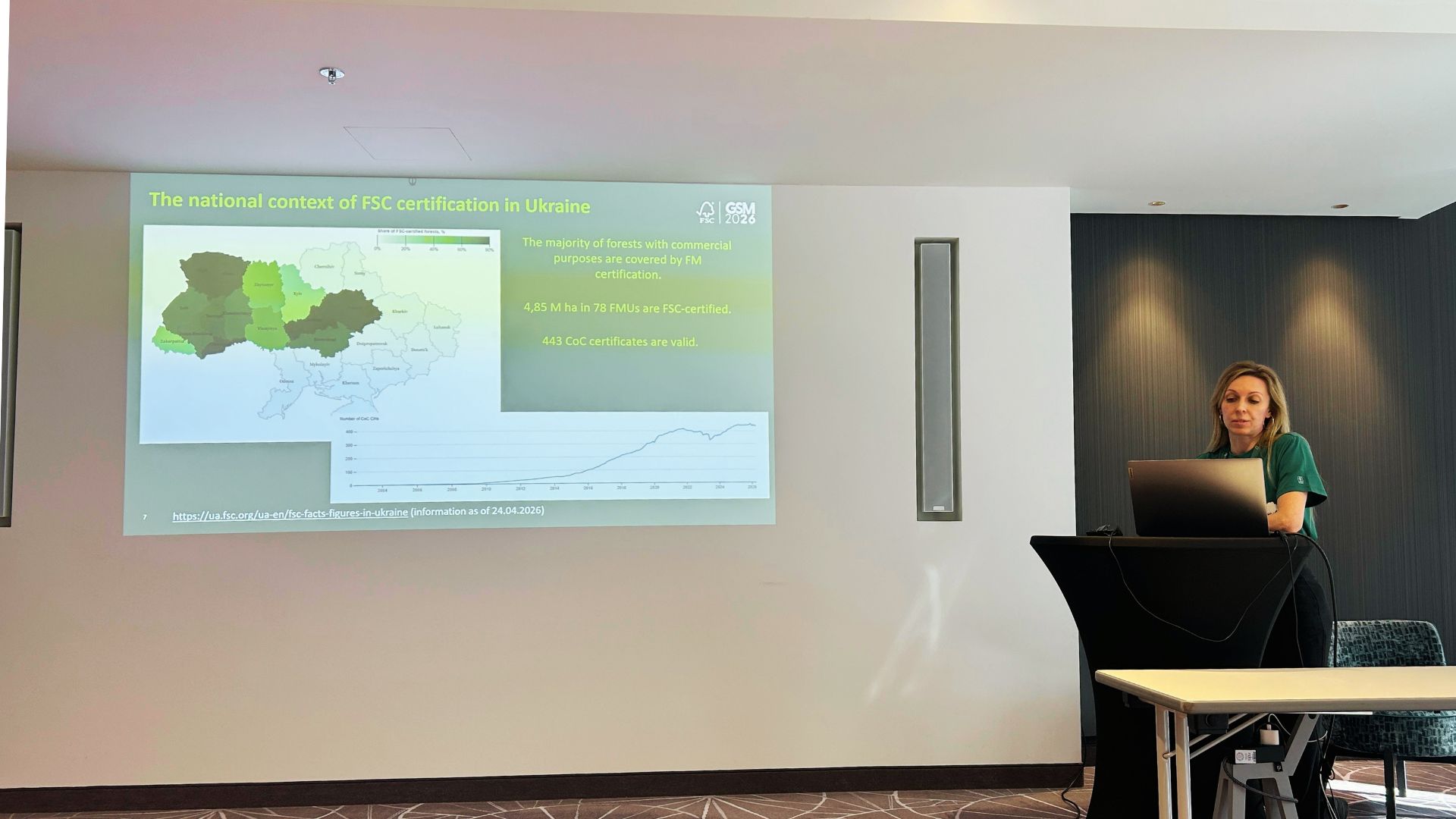
This adaptive capacity and the corresponding response measures proved decisive in the case of Ukraine, presented by Oksana Pavlishchuk, Forest Management Manager, and Nadiia Irodovska, EUDR Manager at FSC Ukraine. The country's extraordinary circumstances stem primarily from Russia's full-scale invasion of Ukraine in 2022. Changes to the FSC certification regulatory framework – affecting both certificate holders and certification bodies – represented one dimension of the system's response. These measures were essential to preserving and sustaining FSC certification in Ukraine, which is critical to the country's economy, environmental protection and the safety of people working in forests.
As of 24 April 2026, certificates covering 4.85 million hectares across 78 forest management units remain valid in Ukraine, and 443 chain-of-custody certificate holders continue to operate.
Ukraine is not alone on the global map of extraordinary circumstances. Romania has spent years countering media campaigns that rely on the manipulation of facts to undermine confidence in FSC-certified operations. Engagement with journalists, educational initiative and a proactive communications strategy have become the primary tools for strengthening public perception of FSC-certified companies.
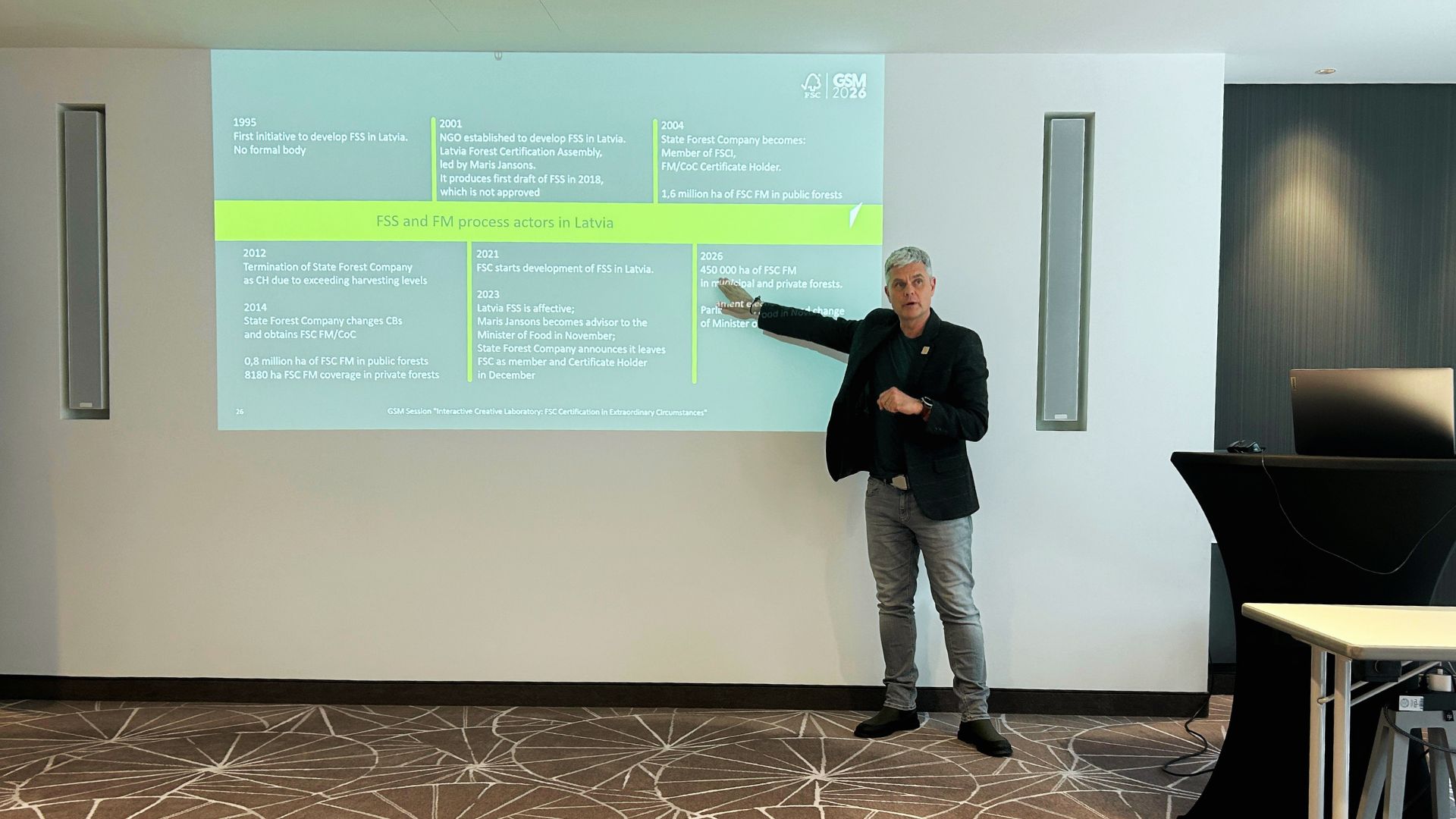
In Latvia, the state forest company announced its withdrawal from the system following a change in government – a case that demonstrated how vulnerable certification can be to institutional decisions made outside the system, often without substantiated justification.
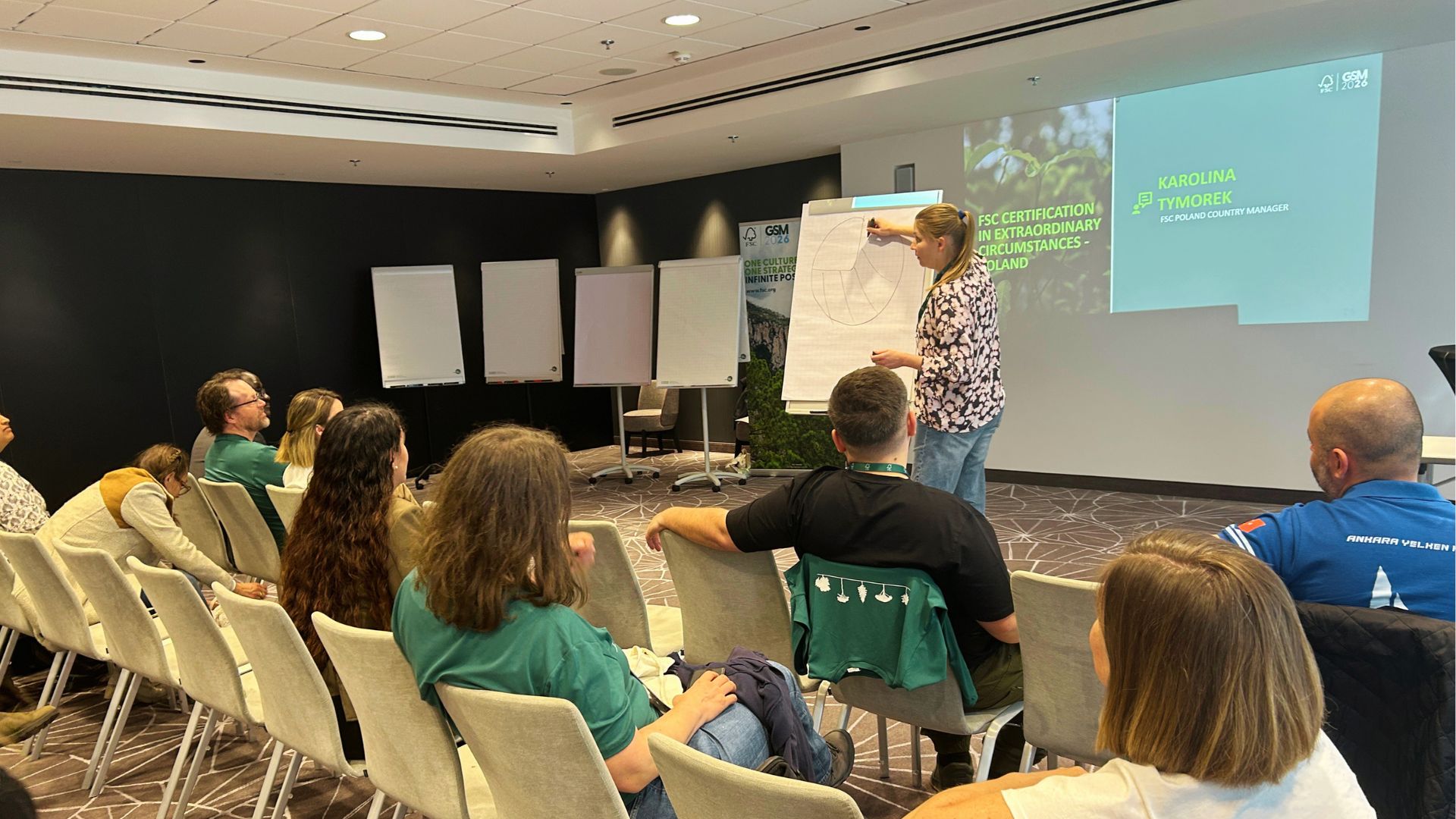
Poland faced comparable challenges. Within a year certified forest area fell from almost 7 ha to 1.7 million ha in early 2024. Recovery became possible through the rapid and tailored response of FSC Poland and FSC International and engagement with Polish State Forests and Ministry of Climate and Environment. Due to joint efforts of FSC and forest managers from the State Forests, certified area have since grown to over 6 million hectares.

In Africa, forests are not destroyed out of indifference. The pursuit of livelihoods is the structural driver behind deforestation. The continent loses approximately 4 million hectares of forest every year – a direct consequence of people doing what they must, to survive. Dr. Peter O. Alele, FSC Africa Regional Director, cited an African proverb that captures this logic precisely: it is survival, not bravery, that makes a man climb a thorny tree. He also shared his experience of finding workable approaches for countries where armed conflict has persisted for years – among them South Sudan and the Democratic Republic of Congo, home to the world's second largest forest after the Amazon. "Where lack of livelihoods is a structural driver; technical standards are not enough", said Dr. Peter O.Alele. He proposed workable approaches including creating viable, legal economic alternatives for local communities, curbing the drivers of conflict and environmental destruction, and establishment of legal, inclusive governance structures that give communities genuine ownership.
While each case is unique, the framework for operating under extraordinary circumstances proved to be shared across countries. Session participants were united in identifying the measures needed to maintain system resilience: constructive dialogue and openness among system actors; a thorough understanding of national context; a risk-based approach embedded in FSC's regulatory framework; and adaptability of normative mechanisms alongside the capacity for rapid response.
"How the FSC system responds to extraordinary circumstances is critical. By fostering active dialogue and exchanging experience, we can strengthen the system and establish aligned, effective crisis-response practices," said Clare Coleman, FSC Regional Director for Europe, who took an active part in the discussion and thanked the Ukraine team for the initiative and for bringing together colleagues from other countries.
"The FSC system must be prepared for any challenge and any extraordinary circumstances," said Pavlo Kravets, Director of FSC Ukraine. "Raising this discussion at the level of GSM is an important step – one that will drive proactive action within the organisation to safeguard the resilience and integrity of the system."
The FSC certification system is capable of operating under any circumstances – but only when every actor within it upholds professional standards and shared accountability drives continuous improvement. Progress is possible only through openness to new experience and knowledge, regardless of the conditions in which that experience is gained.